
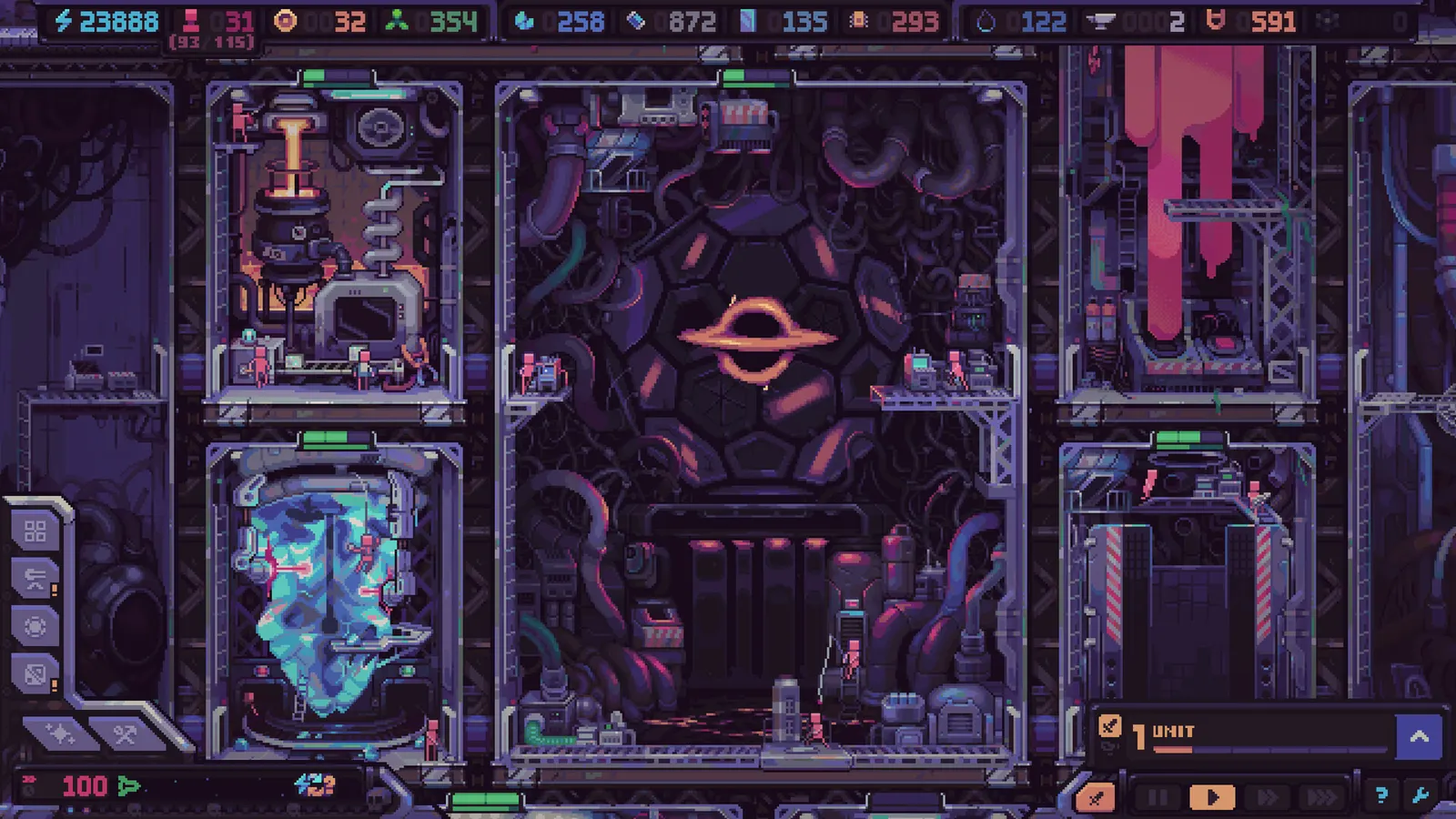
Hull Rupture holds 75% positive from 306 user reviews on Steam, which the storefront labels Mostly Positive. That figure was read on 15 November 2026 and it moves as reviews accumulate.
The ten reviews Steam surfaces first on the community hub tell a different story: eight of them are negative. They are also the longest and most specific, which is how the hub ranks them — a review gets marked helpful for explaining what went wrong in a run, not for saying the art is nice.
The 75% and the wall of negatives are not a contradiction
A sample of 306 reviews is small enough that a few detailed complaints dominate the visible page. The reviews collected on 4–7 November split cleanly by what the reviewer wanted from the game.
Reviewers who came for building — laying out chambers, chaining resource modules, watching a turret line hold — write positive reviews and mention the loop. Reviewers who came for a run they could plan write negative ones and mention the shop. Very few of either group disagrees about the rest of the game.
What the positive reviews agree on
The art and animation come up in almost every favourable review, including the ones that end in a thumbs down. One 17.4-hour review opens "This game is brimming with character and love, and the animation is so so good", then spends four paragraphs on the shop.
The loop is not in dispute. A run is twenty waves: build chambers, fill them with modules that produce resources, spend those resources on defences, then let the aliens tear through the hull on a schedule the game tells you in advance. Travel between waves takes you to stations where you buy, trade or take an event, and the story encounters that fire along the route change what the next wave looks like. A 4.0-hour review describes the resource chains as "interesting", the modules as having "various modifiers", and points out that defences are split between turrets in the hall and defenders in the airlock, each with a wide roster.
Three ships, six modes and four difficulty levels sit on top of that, so the complaint is never that there is nothing to do.
The shop is the argument
Nearly every negative review lands on the same system: the between-wave shop and the drops that feed it. The objection is not that randomness exists in a roguelite. It is that specific, non-substitutable buildings are gated behind it.
An 11.5-hour review states the requirement plainly. By wave 3 you need a Plasteel generator, one or two microchip generators, and jellyfish energy generators — and if the jellyfish generators do not appear, the run is over regardless of how well the ship is laid out, because four upgraded larva generators at full capacity still cannot cover the energy draw.
Two more complaints follow from the same place. The packs that hand out resource modules are diluted by energy and human modules, so the drop you need competes with two you do not. And high-tier modules arrive before the resources to run them, which turns a lucky roll into dead inventory. A 4.2-hour review compares the result to a colony builder where you start unable to make planks: "There are a lot of buildings hard locked behind certain resources with no substitutes."
A 6.8-hour review goes after the deck itself, arguing the tiers prevent commitment: cards are divided by tier, so a run that opens on humans and biofuel cannot stay there, and there is no way to force a suit the way a deckbuilder lets you.
Classic is easy, and everything above it is a dice roll
The difficulty curve is the second theme, and it is not the curve anyone expected. Classic — the normal setting — is described as too easy by reviewers who then could not finish a single run above it. One 11.5-hour review won five Classic runs in a row, four of them without an enemy reaching the despot room, then called the next tier up impossible without "praying to RNG-Jesus" for a clean shop.
A 22.8-hour review reports the same wall at hard, naming isotopes as the resource that decides it: by wave 5, without upgrades to the starting turrets, the gauss or the acid throwers, the run is lost.
That shape — trivial below, luck-gated above — is why the negative reviews keep describing the game as wasting their time rather than as too difficult. It also explains why the two floors of the difficulty ladder feel like different games.
What is still broken in the launch build
Three bugs recur in reviews from the first week, all of them reported by players who reached the late game:
- Endless mode past day 40. Enemy health stops refreshing correctly. A 16.2-hour review describes a unit displaying 590,000 health that absorbed two million damage without dying.
- Room textures persisting after a room is deleted, which blocks interaction with whatever the room was covering.
- Boss health bars staying on screen after the boss dies.
Patches have shipped steadily since launch — 1.0.13 on 5 November, 1.0.15 on 7 November and 1.0.16 on 8 November — and 1.0.15 reworked how difficulty unlocks. The full list, and which of the three bugs each build touched, sits in the patch notes.
If you played the demo
The demo ran for months before launch and gathered its own following, and the release build moved away from it. A 0.8-hour review from someone with over twenty hours in the demo describes the change as replacing a space-management puzzle with something that limits how the run can go, and says the demo's events — around fifteen, then repeats — were the one thing that needed expanding.
The same reviewer, and a 4.2-hour one, note that the packs now mix energy and human modules into resource drops, which is the demo change that hurts most: the demo let you chase a specific module, the release makes you take what the shop offers.
One early negative review was later edited into a recommendation after the developers adjusted drop timing in a patch, saying the early drops now arrive soon enough to pivot into whatever the later game demands.
Who the 75% is for
Hull Rupture lands for players who like watching a production chain come together and are willing to lose runs to a bad shop. The building layer is deep enough that house layouts, module modifiers and the turret-versus-defender split reward a second and third attempt.
It does not land for players who want to plan a run and execute it. The system that decides whether a run is winnable is the one you cannot influence, and the reviews that bounce off the game bounce off exactly there. Anyone arriving from a colony builder or a deckbuilder with strong drafting control should expect the opposite of that, at least in the current build.